Post 16 Options
National Careers Week Parents’ Guide is available here to support you and your child in exploring future career possibilities together.
At Chiltern Hills Academy, you will be offered independent personal guidance, information and support to help you make key decisions about your future. All students in Year 11 have a personal 1:1 careers interview with our professionally qualified Careers Adviser, Chloe Lewis and each student will receive a personalised Careers Action Plan following the interview.
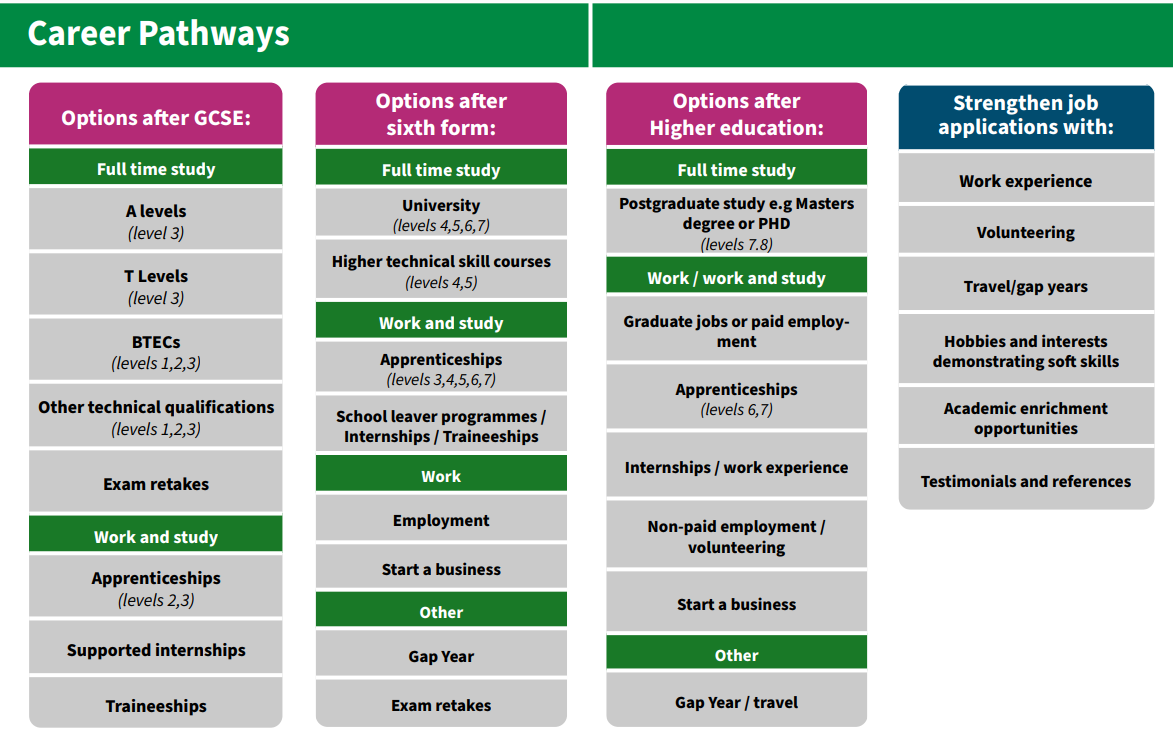
There are 3 main pathways for Year 11s to consider when deciding next steps.
Sixth form
A popular option with CHA students who have completed their GCSEs and want to continue with their academic studies. Sixth form provides a more focused and academically rigorous environment offering a wide range of A level and vocational BTEC courses.
We also offer courses at Level 2 for those students who need to re-sit their Maths and English GCSE.
College
You can also choose to attend college which offer a wider range of vocational qualifications (BTEC & T Levels) as well as A levels and provide a more flexible and diverse learning environment.
T-Levels are new nationally recognised 2 year qualification which are taken after GCSEs at collage and are worth the same UCAS points as 3 Alevels. Leading businesses and employers helped design T-Levels so that the content meets the needs of industry. You can gain on-the-job experience through an industry placement of at least 315 hours (45 days).
These local colleges offer T Levels and more vocational courses
West Herts College and video here
Aylesbury UTC - a technical college specialising in Computing and Health and Social Care
Apprenticeships
Apprenticeships offer a more hands-on and practical approach to learning, Apprenticeships enable you to gain real life experience while you earn and study towards a relevant qualification and are a great option for students who want to get a head start in a particular industry and prefer a more hands-on learning experience.
Alongside on-the-job training, apprentices spend at least 20% of their working hours completing classroom based learning with a college or training provider which leads to a nationally recognised qualification.
More information on Apprenticeships as well as useful websites and resources here
Is an Apprenticeship right for me?
Find out the pros and cons in this 2-minute video from Unifrog
Please also see the comprehensive Parents Guide to Next Steps in the attachment below the summary diagram.